Alignment Step 2: Full-Resolution Recovery
Alignment of full slices
[1]:
import torch
import pandas as pd
from scipy.spatial import distance
import numpy as np
from raftup import (
    _downsample,
    _fsgw_utils,
    _metrics_two_gpr,
    _load_data,
    _plot,
    _recoverfull_new_new_knn
)
/opt/anaconda3/envs/raftup/lib/python3.10/site-packages/dask/dataframe/__init__.py:31: FutureWarning: The legacy Dask DataFrame implementation is deprecated and will be removed in a future version. Set the configuration option `dataframe.query-planning` to `True` or None to enable the new Dask Dataframe implementation and silence this warning.
  warnings.warn(
/opt/anaconda3/envs/raftup/lib/python3.10/site-packages/xarray_schema/__init__.py:1: UserWarning: pkg_resources is deprecated as an API. See https://setuptools.pypa.io/en/latest/pkg_resources.html. The pkg_resources package is slated for removal as early as 2025-11-30. Refrain from using this package or pin to Setuptools<81.
  from pkg_resources import DistributionNotFound, get_distribution
[2]:
#  load anndata and downsampled data

section_ids_list = [['151508', '151509']]
pair = "151508_151509"

for section_ids in section_ids_list:
    dataset = section_ids[0] + '_' + section_ids[1]

    sliceA = _load_data.load_DLPFC(section_id=section_ids[0])
    sliceB = _load_data.load_DLPFC(section_id=section_ids[1])

random_state = 23
np.random.seed(random_state)
tar_distance = 1020

downsampled_sliceA,indices_dsa = _downsample.downsample_slice(sliceA, tar_distance)


downsampled_sliceB,indices_dsb = _downsample.downsample_slice(sliceB, tar_distance)


np.save(f"./results/align_data/{pair}_downsample_indices_dsa.npy", indices_dsa)
np.save(f"./results/align_data/{pair}_downsample_indices_dsb.npy", indices_dsb)
/Users/salovjade/Library/CloudStorage/Dropbox/raftup_repo/src/raftup/_load_data.py:12: FutureWarning: Use `squidpy.read.visium` instead.
  ad = sc.read_visium(path=os.path.join(root_dir, section_id), count_file=section_id+'_filtered_feature_bc_matrix.h5')
/opt/anaconda3/envs/raftup/lib/python3.10/site-packages/anndata/_core/anndata.py:1832: UserWarning: Variable names are not unique. To make them unique, call `.var_names_make_unique`.
  utils.warn_names_duplicates("var")
/Users/salovjade/Library/CloudStorage/Dropbox/raftup_repo/src/raftup/_load_data.py:12: FutureWarning: Use `squidpy.read.visium` instead.
  ad = sc.read_visium(path=os.path.join(root_dir, section_id), count_file=section_id+'_filtered_feature_bc_matrix.h5')
/opt/anaconda3/envs/raftup/lib/python3.10/site-packages/anndata/_core/anndata.py:1832: UserWarning: Variable names are not unique. To make them unique, call `.var_names_make_unique`.
  utils.warn_names_duplicates("var")
[3]:
# load gene cost

PT_PATH = f"./results/gene_cost_matrix/{pair}_somde_cost_matrix.pt"

C = torch.load(PT_PATH, map_location="cpu")
M = C.numpy()

D_A_test = distance.cdist(downsampled_sliceA.obsm['spatial'], downsampled_sliceA.obsm['spatial'])
D_B_test = distance.cdist(downsampled_sliceB.obsm['spatial'], downsampled_sliceB.obsm['spatial'])

testA = D_A_test[D_A_test>0]
testB = D_B_test[D_B_test>0]
print(np.min(testA), np.min(testB))
137.00364958642524 279.0788419067271
Check the performance of downsampled alignment. In general, better downsampled alignment induces better full alignment.
[4]:
# load downsampled alignment

from pathlib import Path
import numpy as np

cutoff_GW_standard = int(np.max([np.min(testA), np.min(testB)]))
print("GW cutoff:", cutoff_GW_standard)


SAVE_DIR = Path("./results/align_data")

load_path = SAVE_DIR / f"ds_matching_{pair}_{206}_{0.2}.npy"

P_1 = np.load(load_path)

P_hard = np.zeros_like(P_1)
row_max_idx = P_1.argmax(axis=1)
P_hard[np.arange(P_1.shape[0]), row_max_idx] = P_1[np.arange(P_1.shape[0]), row_max_idx]

test_label_sub = np.concatenate((np.array(downsampled_sliceA.obs['original_clusters']),np.array(downsampled_sliceB.obs['original_clusters'])),axis=0)
XA_sub = downsampled_sliceA.obsm['spatial']
XB_sub = downsampled_sliceB.obsm['spatial']

full_dela_raftup_LAA = _metrics_two_gpr.cal_layer_based_alignment_result_full_skip_all_zero(P_hard, test_label_sub)

nonzero_rows = np.count_nonzero(np.any(P_hard != 0, axis=1))
n_rows = P_hard.shape[0]

print("transported P_1 mass:", P_1.sum())
print("binarized transported ratio:", nonzero_rows / n_rows)
print("full_LAA:", full_dela_raftup_LAA[0])

col_nnz = np.count_nonzero(P_hard, axis=0)
conflict_cols = np.where(col_nnz >= 2)[0]
num_conflict_cols = len(conflict_cols)

print("Number of columns with >=2 nonzeros:", num_conflict_cols)

print(P_hard.shape)

_plot.plot_3d(sliceA.obsm['spatial'], sliceB.obsm['spatial'], P_hard, indices_dsa, indices_dsb, linewidth=0.5)
GW cutoff: 279
0.8705882352941177 0.12941176470588237 0.0 0.0 0.0 0.0 0.0
transported P_1 mass: 0.4473684210526131
binarized transported ratio: 0.46195652173913043
full_LAA: 0.8705882352941177
Number of columns with >=2 nonzeros: 0
(184, 190)
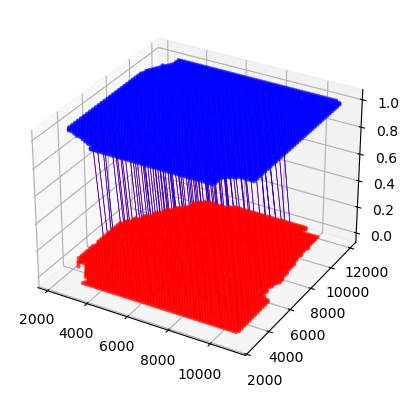
In general, the gene cutoff \rho{f_2} in full alignment is larger than the gene cutoff :nbsphinx-math:`rho`{f_1} in downsampled alignment to enlarge more spots aligned near the anchor spots (downsampled/aligned spots). A preferable ratio of \rho{f_2} over :nbsphinx-math:`rho`{f_1} is 2.
The spatial cutoff \rho_t is the same as the spatial cutoff \rho_s in downsampled alignment. In general, a preferable ratio of \rho_s over \rho_s is less than or equal to 1.
k_1 and k_2 are two parameters for generating the spatial cost of full slices given aligned anchor spots. For spot \alpha `in sliceA and spot :nbsphinx-math:beta in sliceB, the spatical cost between :nbsphinx-math:alpha and :nbsphinx-math:beta `is fully determined by the k_1 aligned anchor spots of subsliceA and the k_2 aligned anchor spots of subsliceB. The default k_1 = k_2 = 10.
[5]:
# knn recover full

thresh_CCC_list = {0.4}

thresh_CGW_list = {206}


test_label_full = np.concatenate((np.array(sliceA.obs['original_clusters']),np.array(sliceB.obs['original_clusters'])),axis=0)
XA_full = sliceA.obsm['spatial']
XB_full = sliceB.obsm['spatial']

for thresh_CCC in thresh_CCC_list:
    for thresh_CGW in thresh_CGW_list:
        print(f"Running alignment for section pair")
        P_full_knn = _recoverfull_new_new_knn.recover_full_mapping_knn(
            M = M,
            X1 = sliceA.obsm['spatial'],
            X2 = sliceB.obsm['spatial'],
            P  = P_hard,
            idx1 = indices_dsa,
            idx2 = indices_dsb,
            k1 = 10,
            k2 = 10,
            thresh_CGW=thresh_CGW,
            thresh_CCC=thresh_CCC,
            eps=0.01
        )
        P_full_dense_knn = P_full_knn.toarray()

        full_dela_raftup_LAA = _metrics_two_gpr.cal_layer_based_alignment_result_full_skip_all_zero(P_full_dense_knn, test_label_full)
        full_dela_raftup_GPR_300= _metrics_two_gpr.GPR_original(P_full_dense_knn , XA_full, XB_full, dis_cut=300, P_cut=1e-19)
        full_dela_raftup_GPR_600= _metrics_two_gpr.GPR_original(P_full_dense_knn , XA_full, XB_full, dis_cut=600, P_cut=1e-19)
        full_dela_raftup_GPR_900= _metrics_two_gpr.GPR_original(P_full_dense_knn , XA_full, XB_full, dis_cut=900, P_cut=1e-19)

        print("thresh CCC is:", thresh_CCC )
        print("thresh CGW is:", thresh_CGW )
        print("transported mass:", P_full_dense_knn.sum())
        print("full_dela_raftup_LAA:", full_dela_raftup_LAA[0])

        print("full_dela_raftup_GPR_300:", full_dela_raftup_GPR_300)
        print("full_dela_raftup_GPR_600:", full_dela_raftup_GPR_600)
        print("full_dela_raftup_GPR_900:", full_dela_raftup_GPR_900)
        np.save(f'./results/align_data/full_matching_{pair}_{thresh_CGW}_{thresh_CCC}.npy',P_full_dense_knn)
Running alignment for section pair
recover_full_mapping_knn: 75%|███████▌ | 6/8 [02:46<00:55, 27.55s/it]
Number of blocked positions in recover_full sOT (kNN): 20961693
Number of possible aligned positions (kNN): 14535
Number of iterations in unot: 15011, final error: 9.89e-09
0.8671351006068349 0.1306291919514532 0.0 0.0 0.0 0.0 0.002235707441711913
thresh CCC is: 0.4
thresh CGW is: 206
transported mass: 0.6497482769542751
full_dela_raftup_LAA: 0.8671351006068349
full_dela_raftup_GPR_300: 0.8624001047963583
full_dela_raftup_GPR_600: 0.9065542319241768
full_dela_raftup_GPR_900: 0.9359730165214817